|Authors=J. Sanz Subirana, J.M. Juan Zornoza and M. Hernández-Pajares, Technical University of Catalonia, Spain.
|Authors= J. Sanz Subirana, JM. Juan Zornoza and M. Hernandez-Pajares, University of Catalunia, Spain.
|Level=Advanced
|Level=Advanced
|YearOfPublication=2011
|YearOfPublication=2011
|Logo=gAGE
|Title={{PAGENAME}}
}}
}}
A scheme with the necessary calculations to obtain the osculating orbital elements starting from the position and velocity of a satellite in a geocentric inertial system, and vice-versa, is provided as follows (see figure 1):
== Calculation of the orbital elements of the satellite from its position and velocity ==
A scheme with the necessary calculations to obtain the osculating orbital elements starting from the position and velocity of the satellite, and vice-versa, is provided as follows (see figure 1):
::<math> (x, y, z, v_x, v_y, v_z) \Longrightarrow (a, e, i, \Omega, \omega, M) \qquad \mbox{(1)}</math>
== Calculation of the orbital elements of the satellite from its position and velocity ==
::<math> \vec c= \vec r \times \vec v \Longrightarrow p=\frac{c^2}{\mu} \Longrightarrow p \qquad \mbox{(2)}</math>
::<math> v^2=\mu (2/r -1/a) \Longrightarrow a \qquad \mbox{(3)}</math>
::<math> (x, y, z, v_x, v_y, v_z) \Longrightarrow (a, e, i, \Omega, \omega, M) </math>
::<math> p=a(1-e^2) \Longrightarrow e \qquad \mbox{(4)}</math>
::<math> \vec c= \vec r \times \vec v \Longrightarrow p=\frac{c^2}{\mu} \Longrightarrow p </math>
::<math> \vec c = c \vec S \Longrightarrow \Omega=\arctan(-c_x/c_y); i=arcs(c_z/c) \Longrightarrow \Omega, i \qquad \mbox{(5)}</math>
::<math> v^2=\mu (2/r -1/a) \Longrightarrow a </math>
::<math> p=a(1-e^2) \Longrightarrow e </math>
::<math> \vec c = c \vec S \Longrightarrow \Omega=\arctan(-c_x/c_y); i=arcs(c_z/c) \Longrightarrow \Omega, i </math>
Line 48:
Line 48:
\end{array}
\end{array}
\right)
\right)
\Rightarrow \omega+V
\Rightarrow \omega+V
\qquad \mbox{(6)}
</math>
</math>
::<math> r=\frac{p}{1+e\cos(V)} \Longrightarrow \omega, V </math>
::<math> r=\frac{p}{1+e\cos(V)} \Longrightarrow \omega, V \qquad \mbox{(7)}</math>
::<math> \tan(E/2)=(\frac{1-e}{1+e})^{1/2}\tan(V/2) \Longrightarrow E </math>
::<math> \tan(E/2)=(\frac{1-e}{1+e})^{1/2}\tan(V/2) \Longrightarrow E \qquad \mbox{(8)}</math>
::<math> M= E -e \sin E \Longrightarrow M </math>
::<math> M= E -e \sin E \Longrightarrow M \qquad \mbox{(9)}</math>
Line 66:
Line 66:
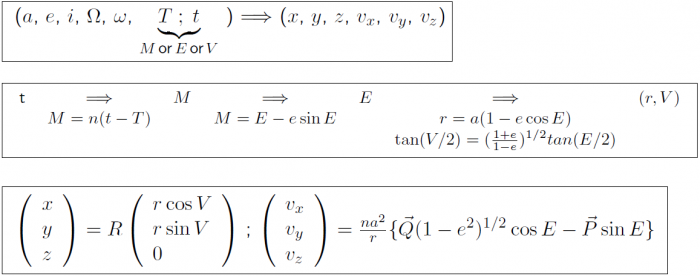
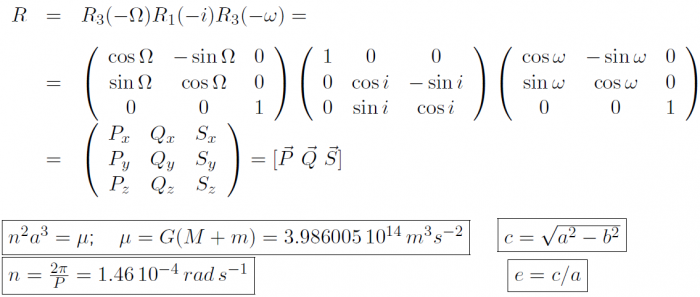
== Calculation of the position and velocity of the satellite from its orbital elements ==
== Calculation of the position and velocity of the satellite from its orbital elements ==
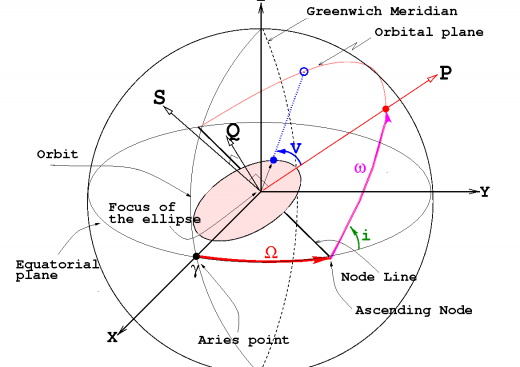
:::[[File:Osculating_Elem_Fig_3.png|none|thumb|400px|'''''Figure 1:''''' Orbit in space.]]
:::[[File:Osculating_Elem_Fig_3.png|none|thumb|520px|'''''Figure 1:''''' Orbit in space.]]
[[Category:Fundamentals]]
[[Category:Fundamentals]]
[[Category:GNSS Measurements and Data Preprocessing]]
Latest revision as of 10:34, 13 January 2013
Fundamentals
Title
Osculating Elements
Author(s)
J. Sanz Subirana, J.M. Juan Zornoza and M. Hernández-Pajares, Technical University of Catalonia, Spain.
Level
Advanced
Year of Publication
2011
A scheme with the necessary calculations to obtain the osculating orbital elements starting from the position and velocity of a satellite in a geocentric inertial system, and vice-versa, is provided as follows (see figure 1):
Calculation of the orbital elements of the satellite from its position and velocity
[math]\displaystyle{ (x, y, z, v_x, v_y, v_z) \Longrightarrow (a, e, i, \Omega, \omega, M) \qquad \mbox{(1)} }[/math]
[math]\displaystyle{ \vec c= \vec r \times \vec v \Longrightarrow p=\frac{c^2}{\mu} \Longrightarrow p \qquad \mbox{(2)} }[/math]
[math]\displaystyle{ v^2=\mu (2/r -1/a) \Longrightarrow a \qquad \mbox{(3)} }[/math]
[math]\displaystyle{ p=a(1-e^2) \Longrightarrow e \qquad \mbox{(4)} }[/math]
[math]\displaystyle{ \vec c = c \vec S \Longrightarrow \Omega=\arctan(-c_x/c_y); i=arcs(c_z/c) \Longrightarrow \Omega, i \qquad \mbox{(5)} }[/math]
[math]\displaystyle{
\left(
\begin{array}{l}
x\\
y\\
z
\end{array}
\right)
= R
\left(
\begin{array}{l}
r \cos(V)\\
r \sin(V)\\
0
\end{array}
\right)
= r
\left(
\begin{array}{l}
\cos \Omega \cos(\omega+V)- \sin \Omega \sin(\omega+V) \cos i\\
\sin \Omega \cos(\omega+V)+ \cos \Omega \sin(\omega+V) \cos i\\
\sin(\omega+V) \sin i
\end{array}
\right)
\Rightarrow \omega+V
\qquad \mbox{(6)}
}[/math]
[math]\displaystyle{ r=\frac{p}{1+e\cos(V)} \Longrightarrow \omega, V \qquad \mbox{(7)} }[/math]
[math]\displaystyle{ \tan(E/2)=(\frac{1-e}{1+e})^{1/2}\tan(V/2) \Longrightarrow E \qquad \mbox{(8)} }[/math]
[math]\displaystyle{ M= E -e \sin E \Longrightarrow M \qquad \mbox{(9)} }[/math]
Calculation of the position and velocity of the satellite from its orbital elements